Lateral vs Vertical File Cabinets: Which Is Better? (October 2026)
For the lateral vs vertical file cabinet choice, pick lateral for broad drawers or vertical to save floor width. Check open-drawer clearance, folder size and reachable storage before you buy.
On this page (10 sections)
- Lateral vs vertical file cabinet: what is the main difference?
- Which cabinet fits a small office?
- Which drawer layout makes papers easier to reach?
- Which cabinet works for letter and legal folders?
- How much filing space do you actually need?
- Who should buy each of these cabinets?
- How should you set up and load a file cabinet?
- What care keeps file drawers working well?
- Which buying mistakes should you avoid?
- Which file cabinet should you choose?
Choose a lateral file cabinet for broad drawers or a vertical cabinet to save floor width. The lateral vs vertical file cabinet decision comes down to available space, folder size and how you reach your papers.
A wide cabinet can work well along an open wall, while a narrow cabinet can fit beside a desk. Neither shape automatically holds more, and a vertical cabinet doesn't have to be tall.
Start with the files you keep, then measure where the cabinet will go. A cabinet that fits with its drawers closed can still block your chair or doorway during use.
 Best for shared filing spaces
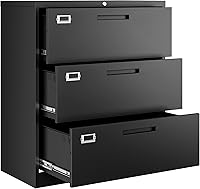
Letaya 3-Drawer Lateral File Cabinet with Lock
 Best for narrow office corners
MIIIKO 4-Drawer Metal File Cabinet with Lock
Lateral vs vertical file cabinet: what is the main difference?
The main difference is drawer width and layout: lateral cabinets have broad drawers, while vertical cabinets stack narrower drawers. Height, depth and supported folder sizes depend on the model.
Lateral drawers spread files across a wider area, which can suit several related groups in one drawer. Hanging-bar placement determines how you arrange those folders, so don't assume every lateral model uses the same filing direction.
Vertical drawers divide storage into narrower compartments. That can make it simple to give each drawer a purpose, such as household records, client work or archived papers.
The examples here show why the shape alone isn't enough. The MIIIKO is a tall vertical cabinet, but the Staples is a low vertical cabinet with an accessory drawer.
For more detail on the wide format, see what a lateral file cabinet is. Our complete file cabinet buying guide covers the broader choices, including materials and storage needs.
Which cabinet fits a small office?
A vertical cabinet suits a narrow gap, while a lateral cabinet needs a wider stretch of wall. Compare depth and open-drawer clearance before deciding which uses your room better.
The Letaya measures 36 in wide, 16 in deep and 40 in high. The MIIIKO is 15 in wide, 17.71 in deep and 50.11 in high.
The Staples measures 14.3 in wide, 18.9 in deep and 26.8 in high. It is the shortest option here, but it also extends farthest from the wall.
That makes the Letaya worth considering along a broad wall where front-to-back space is tight. The MIIIKO makes more sense when width is scarce and the space above the cabinet is clear.
A narrow footprint won't help if the cabinet projects into your walking route. Include baseboards, door swings and chair movement when you mark out the location.
How do you measure for a lateral or vertical file cabinet?
Measure usable width, depth and height, then check the space needed to open a drawer and reach inside. Use the file cabinet size guide to understand common dimensions before comparing models.
- Tape the cabinet footprint on the floor.
- Check nearby doors and the path of your desk chair.
- Measure below shelves, desk braces and keyboard trays.
- Allow space for an open drawer and your body in front of it.
- Check the delivery route, including stairs and tight turns.
Cabinet depth alone doesn't tell you the full space needed during use. Check drawer extension measurements where available before putting a cabinet in a tight passage.
Under a desk, preserve enough knee room to sit squarely at your work. The home office file cabinet guide can help you balance storage with a usable workstation.
Which drawer layout makes papers easier to reach?
Choose broad drawers for grouped files or separate drawers for distinct categories. The better layout lets you find and return routine papers without moving other folders first.
Think about the last few documents you needed. If you often pull papers from several related categories, keeping those folders together may reduce the number of drawers you open.
If your files divide naturally by person, project or business, separate drawers can make boundaries clearer. Shared cabinets also need labels that another person can understand without asking you.
Height matters as much as drawer width. Put frequently used files at a comfortable reach, with lighter, less-used papers in the upper drawers and heavier contents lower down.
A low cabinet puts storage near a seated work area, but retrieving files may still require bending. Avoid placing it where the desk edge prevents you from seeing or reaching the back of a drawer.
Full-extension rails can help expose more of a drawer's contents; MIIIKO includes them. Even with that feature, tightly packed folders remain awkward to separate.
Which cabinet works for letter and legal folders?
Both cabinet styles can hold legal files, but only when their rails support that size. The Letaya accepts letter, legal, F4 and A4 hanging folders; the MIIIKO accepts letter, legal and A4.
The Staples is designed for letter-size hanging files. Skip it if legal-size hanging folders are part of your regular filing system.
Check the folders themselves, not just the paper inside them. A document folded into a smaller folder has different storage needs from a legal document kept flat in a legal-size hanging folder.
Adjustable rails help accommodate different formats, but plan each drawer's arrangement before loading it. Don't assume you can mix every supported size side by side in any configuration.
If you already have hanging folders, inspect their hooks and condition before moving them. Our guide to hanging folders and file cabinet rails explains how the support system works.
How much filing space do you actually need?
Count usable file drawers and current folder volume, then allow room for folders to move. A drawer packed tight from day one leaves little space for new records or easy browsing.
Sort your papers before buying a larger cabinet. Separate active records from old material you can discard under your own retention needs, and avoid storing duplicate copies without a reason.
Group the remaining folders by category and note which groups are likely to grow. A drawer that holds several slim folders today may fill quickly if those folders collect monthly statements or project paperwork.
Don't treat the same drawer count as equal capacity. The Letaya has 3 broad file drawers, the MIIIKO has 4 narrower file drawers, and the Staples has 2 file drawers plus an accessory drawer.
The outside measurements don't guarantee usable filing length or a safe load limit. Follow each cabinet's instructions rather than estimating how much weight it can hold from its size or steel construction.
Before moving papers in, build a simple home filing system. Clear categories and readable tabs are more useful than extra drawers filled without a plan.
Who should buy each of these cabinets?
Choose the Letaya for broad storage, the MIIIKO for narrow, divided storage, or the Staples for a compact letter-file setup. Each solves a different space and filing problem.
Letaya: for a shared filing wall
The Letaya suits a home office or shared work area with enough wall width for broad drawers. Its adjustable hanging bars make sense for a filing system that uses several paper formats.
Powder-coated steel, ball-bearing full-suspension drawers and an all-drawer keyed lock are practical features for routine storage. Letaya describes its interlock as an anti-tip feature.
Skip it if your only available space is a narrow desk-side gap. It also requires assembly, and its height rules out many under-desk positions.
MIIIKO: for separate categories in a narrow space
The MIIIKO suits someone who wants a distinct drawer for each major file group without using much wall width. Its high-side drawers and adjustable hanging rails support a conventional hanging-folder setup.
The top keyed lock secures all 4 drawers, and MIIIKO includes a drawer interlock with an anti-tip mechanism. Its steel construction weighs 90 lb, so plan the route and placement before assembly.
Skip it if you need low storage under a work surface or can't comfortably reach a tall cabinet. It is also a poor choice if you expect to reposition your storage often.
Staples: for everyday files beside a desk
The Staples suits a smaller letter-file collection with pens and office tools nearby. Its accessory drawer gives those small items a separate home instead of mixing them with folders.
It has a built-in keyed lock and ball-bearing drawer glides, and it arrives partially assembled. Its lower height makes it the option here to consider beneath a suitable desk opening.
Skip it if you need legal-size hanging files or several full drawers of paperwork. Count it as a 2-file-drawer cabinet when planning capacity.
How should you set up and load a file cabinet?
Assemble the cabinet fully, place it on a stable, level floor, and follow its anchoring and loading instructions before filling the drawers. Load heavier contents low and open only one drawer at a time.
Check that the frame sits square and that each empty drawer moves as intended. If a drawer binds, inspect assembly alignment before adding files or forcing it shut.
Install hanging bars in the correct positions for your folders. Make sure both folder hooks sit securely on their supports and that tabs don't catch above the drawer opening.
Interlocks reduce the chance of multiple drawers opening together, but they don't replace proper placement or anchoring. Never force a second drawer past an interlock.
Keep children from climbing drawers, and don't use an open drawer as a shelf or step. The OSHA office physical hazard guidance covers filing-cabinet hazards and safe office use.
Put spare keys somewhere separate from the cabinet. A keyed lock controls routine access, but don't assume it provides fire protection or a particular level of resistance to forced entry.
What care keeps file drawers working well?
Keep folders below the drawer opening, remove loose papers from moving parts and avoid overfilling. These habits help prevent snags without making drawer maintenance complicated.
Wipe cabinet surfaces with a soft cloth and a cleaner suited to the finish, then dry them. Avoid abrasive pads and don't spray cleaner directly into the lock or drawer slides.
If movement becomes stiff, unload the affected drawer and check for bent folder hooks, fallen papers or shifted rails. Follow the manufacturer's guidance before applying lubricant or adjusting hardware.
Review labels when you add a new category. Leaving several nearly identical tabs in one drawer makes it easier to misfile documents, even when the cabinet has plenty of room.
Which buying mistakes should you avoid?
The biggest mistakes are measuring only the closed cabinet and choosing by drawer count alone. Folder fit, access and safe placement can matter more than an extra compartment.
- Buying before sorting: old duplicates can make your storage needs look larger than they are.
- Assuming vertical means tall: low vertical cabinets exist, including the Staples option here.
- Assuming lateral means legal-compatible: check supported folder sizes for every model.
- Ignoring drawer contents: an accessory drawer doesn't add hanging-file capacity.
- Filling every inch: crowded folders are harder to browse and return.
- Relying on a lock for stability: a cabinet still needs correct loading and setup.
Avoid choosing a shape only because it resembles office furniture you've used before. Start with your actual room and the papers you need to keep.
Which file cabinet should you choose?
For the lateral vs vertical file cabinet decision, first rule out anything that fails your measurements or folder needs. Then choose the drawer arrangement that puts your most-used papers within easy reach.
Pick the Letaya when you have a broad wall space and want related file groups together. Pick the MIIIKO when a narrow location and separate file categories are your priorities.
Pick the Staples when a smaller letter-file collection and accessory storage cover your needs. Its shorter cabinet is the most relevant option here for a measured under-desk opening.
Before ordering, mark the footprint and check the open-drawer space once more. For other models in your preferred shape, compare our best lateral file cabinets or best 4-drawer file cabinets.
Sources:
Frequently asked questions
What is the difference between lateral and vertical file cabinets?
A lateral cabinet has broad drawers, while a vertical cabinet stacks narrower drawers; lateral models need more wall width, and vertical models can fit narrower spaces. Neither name guarantees a particular height, depth or capacity, so compare actual dimensions and drawer layouts before choosing.
Do lateral file cabinets take up more space?
Lateral cabinets generally need more width, but total floor space depends on depth too; open drawers also need clearance beyond the cabinet's footprint. Measure the space where you'll stand and reach files, then check whether the cabinet would block a doorway, chair or walking route.
Are lateral or vertical file cabinets better for legal-size files?
Either layout works for legal-size files when its hanging rails support them; the Letaya and MIIIKO options here accept legal folders, while the Staples suits letter-size hanging files. Choose the correct folder support first, then decide which cabinet shape fits your room and filing habits.
Can you put a file cabinet under a desk?
Yes, if the usable desk opening fits the cabinet and leaves room for your legs and open drawers; measure below the desk frame, braces and any keyboard tray rather than using the desktop height. The shorter Staples is the option here to consider for that placement.
How do you choose between a lateral and vertical filing cabinet?
Choose lateral if you have wall width and prefer broad drawers, or vertical if a narrow footprint matters more; then check folder compatibility, usable file drawers and open-drawer clearance. Keep frequently used papers within comfortable reach, and leave room for folders to slide without packing them tightly.