9 Best File Cabinets for Home Office (October 2026)
The best home office file cabinets include the DEVAISE 3-Drawer Locking File Cabinet for mixed desk storage, the Staples 3-Drawer Vertical Lockable File Cabinet for letter-file households, and the MIIIKO 4-Drawer Metal File Cabinet with Lock for narrow archive spaces.
On this page (10 sections)
- Which file cabinet for a home office fits your routine?
- How should you compare vertical and lateral cabinets?
- How many file drawers do you actually need?
- What should you measure before buying a home office file cabinet?
- Which folder sizes and hanging rails should you choose?
- When are wheels worth choosing?
- What do locks and anti-tip features protect against?
- How should you set up and care for the cabinet?
- Which buying mistakes should you avoid?
- Which home office file cabinet should you choose?
The DEVAISE 3-Drawer Locking File Cabinet is the best file cabinet for a home office that needs active files and desk supplies in one mobile unit. Choose more dedicated file drawers if paper storage matters more than supply storage.
The key difference is file drawers versus total drawers. A compact three-drawer cabinet may hold fewer hanging folders than a two-drawer model because its upper drawers serve smaller items.
Start with the papers you keep, then measure their future home. Our complete file cabinet buying guide covers the main cabinet types, while our file cabinet dimensions guide explains how to measure your space.
Our picks at a glance
-
1

-
2
 Best for letter-file households
Staples 3-Drawer Vertical Lockable File Cabinet
8.8/10 our score
See it on Amazon -
3
 Best for narrow archive spaces
MIIIKO 4-Drawer Metal File Cabinet with Lock
8.6/10 our score
See it on Amazon
- 4
 Check it
DEVAISE 3-Drawer File Cabinet on Wheels
Best for tight desk gaps - 5
 Check it
Letaya 3-Drawer Mobile Under Desk File Cabinet
Best for movable desk storage - 6
 Check it
Letaya 3-Drawer Lateral File Cabinet with Lock
Best for shared office records - 7
 Check it
Letaya 2-Drawer Lateral Cabinet with Hanging Rails
Best for low wall spaces - 8
 Check it
BYNSOE 2-Drawer Steel Vertical File Cabinet
Best for simple household filing - 9
 Check it
BYNSOE 4-Drawer Vertical File Cabinet with Lock
Best for separate record groups
Which file cabinet for a home office fits your routine?
Choose a mobile pedestal for daily desk storage, a tall vertical cabinet for separate record groups, or a lateral cabinet for wider filing drawers. The picks below suit different filing habits, so start with layout rather than drawer count.
DEVAISE 3-Drawer Locking File Cabinet for home office filing
DEVAISE 3-Drawer Locking File Cabinet: Best for mixed desk storage
- Three locking drawers
- Five wheels, including a center caster
- Hanging files for letter, legal and A4
- Full-extension drawer slides
A mobile choice for keeping active files and smaller office items together. The bottom hanging-file drawer supports three folder formats, and only the casters need installation.
Pros
- Fits letter, legal and A4 hanging folders
- Full-extension drawers reach the back
- Cabinet body arrives assembled
Cons
- Only one hanging-file drawer
- Casters need installation
The DEVAISE is the strongest all-around choice for someone who wants paperwork, pens and small office items within reach. Its bottom drawer handles hanging files, while the upper drawers keep loose supplies from filling your desktop.
The removable hanging bar supports letter, legal and A4 folders, so it suits a household that mixes document formats. Full-extension slides help you reach folders at the back without pulling the front files out first.
Its five-wheel base includes a center front caster, and the cabinet body arrives assembled. You'll need to install the casters before setting it up.
Choose it for current bills, working documents and everyday supplies. Skip it if your main need is a growing archive: one hanging-file drawer can become crowded even while the smaller drawers still have room.
Set up folders before adding supplies, then use the upper drawers for items you actually reach for during work.
Staples 3-Drawer Vertical Lockable File Cabinet: Best for letter-file households
- Two file drawers and one accessory drawer
- Keyed lock
- Ball-bearing drawer glides
- Letter-size hanging-file storage
Two letter-file drawers suit households that need more paper storage than a single-file-drawer pedestal provides. A separate accessory drawer keeps pens and office tools out of the folders.
Pros
- Two dedicated letter-file drawers
- Separate accessory drawer
- Ball-bearing drawer glides
Cons
- Designed for letter-size hanging files
- Partially assembled
The Staples cabinet suits a household with two groups of letter-size files and a smaller collection of desk tools. Its two file drawers offer a useful alternative to mobile pedestals that devote most drawers to supplies.
You could separate household records from work papers or current documents from older reference material. The accessory drawer then gives pens, clips and other small items their own place.
Ball-bearing glides and a keyed lock cover everyday drawer access and basic privacy. The cabinet arrives partially assembled, so allow setup time before transferring your papers.
Choose it if your existing folders are letter size and you want more than one dedicated filing drawer. Skip it if legal-size hanging folders are part of your routine.
Its height also deserves attention under a desk. Measure to the lowest crossbar or center drawer, rather than using the height of the desktop as your clearance.
MIIIKO 4-Drawer Metal File Cabinet with Lock: Best for narrow archive spaces
- Four high-side drawers
- One lock secures all drawers
- Adjustable hanging rails
- Full-extension glide rails
Four file drawers let you separate household records, business papers and project files within a narrow floor area. Adjustable rails support letter, legal and A4 hanging folders.
Pros
- Four filing drawers within a 15 in width
- Supports three hanging-folder sizes
- One lock secures all drawers
Cons
- Assembly required
- Tall cabinet needs a planned location
The MIIIKO suits a paper-heavy office that has more vertical room than wall width. Four high-side drawers let you split records into useful groups without spreading storage across a long wall.
Adjustable hanging rails support letter, legal and A4 folders. Full-extension glide rails help with access to files stored toward the back, while one top lock secures all four drawers.
The cabinet stands just over 50 in tall and weighs 90 lb. Plan its location and moving route before assembly, particularly if your office is upstairs or reached through tight turns.
Choose it for several established filing groups, such as household records, business administration, client papers and reference documents. Skip it if you need storage that rolls between work areas or fits beneath a standard seated desk.
Keep the heaviest papers low and the most frequently used files within comfortable reach. Follow the cabinet's safety instructions even with its anti-tip mechanism.
DEVAISE 3-Drawer File Cabinet on Wheels: Best for tight desk gaps
- Two utility drawers and one file drawer
- Removable stationery tray
- Five casters
- Fully assembled except for casters
The narrow white cabinet suits a desk gap where a wider pedestal would crowd your chair. Two utility drawers and a stationery tray complement the bottom hanging-file drawer.
Pros
- Narrow 11.8 in width
- Includes a stationery tray
- Cabinet body arrives assembled
Cons
- Only one hanging-file drawer
- Casters need installation
The slim DEVAISE is the better fit when a narrow desk gap controls the choice. At 11.8 in wide, it takes less side-to-side room than the other mobile cabinets here.
Two utility drawers and a removable stationery tray make it useful for someone whose desk clutter includes small tools as well as papers. The lower drawer supports hanging folders in letter, legal and A4 formats.
A keyed lock secures the drawers, and the white steel cabinet arrives assembled apart from its casters. Full-extension slides allow access to the rear of the drawers.
Choose it when a wider cabinet would steal chair space or narrow the route beside your desk. Skip it if you need multiple file drawers or expect it to hold an entire household archive.
Mark its footprint on the floor before ordering. A slim cabinet still needs front-to-back space, and its open drawer must clear your chair.
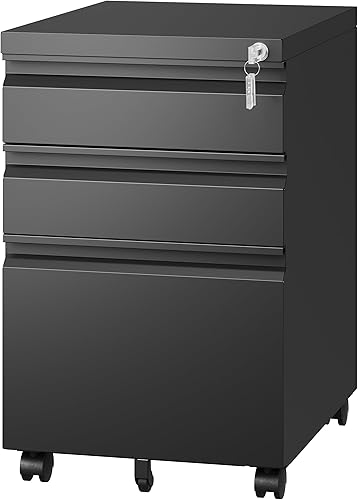
Letaya 3-Drawer Mobile Under Desk File Cabinet: Best for movable desk storage
- Two small drawers and one file drawer
- Two lockable front casters
- One lock secures all drawers
- Adjustable hanging bars
Choose this mobile cabinet when you want to move files near your work and secure the front wheels once parked. The bottom drawer supports letter, legal and A4 hanging folders.
Pros
- Two front casters can be locked
- One lock secures all drawers
- Cabinet body arrives assembled
Cons
- Only one hanging-file drawer
- Under-desk fit depends on desk clearance
The Letaya mobile cabinet suits someone who wants to pull storage closer during work, then park it beneath or beside the desk. Its two lockable front casters are the useful distinction among these mobile options.
The layout puts two small drawers above one hanging-file drawer. Adjustable bars allow letter, legal and A4 folders, and one key lock secures all three drawers.
At 24.4 in high, it needs a clear desk opening above that height, plus room to move it comfortably. The cabinet body arrives assembled, with wheel installation still required.
Choose it for active paperwork and supplies that move with your work position. Skip it if most of your storage needs are hanging files, or if thick carpet and thresholds make rolling storage awkward.
Once parked, engage the front caster locks and check that the cabinet sits steadily. Close the drawers before moving it, and keep its route clear of cables.
Letaya 3-Drawer Lateral File Cabinet with Lock: Best for shared office records
- Three lateral drawers
- One lock secures all drawers
- Adjustable hanging bars
- Ball-bearing full-suspension drawers
Three wide drawers suit records divided among people, clients or projects. This cabinet needs a dedicated wall area and supports letter, legal and A4 hanging folders.
Pros
- Wide drawers for separate file groups
- Adjustable hanging bars
- One lock secures all drawers
Cons
- Needs 36 in of wall width
- Assembly required
The Letaya three-drawer lateral cabinet suits shared records organized by person or project. Wide drawers let you keep related file groups together rather than scattering them among several small storage units.
Its adjustable hanging bars support letter, legal and A4 folders. Ball-bearing full-suspension drawers provide access, and one lock secures the cabinet.
The 36 in width and 40 in height call for a dedicated wall area. Plan it as separate office furniture rather than assuming it will slide under your desk.
Choose it when you can give filing its own place and want three broad divisions for records. Skip it if the only available spot is a narrow gap beside your chair.
Assembly is required, so clear space for the parts and build near the final location. Decide how the files will run before loading the drawers, then label groups consistently so shared users can return papers correctly.
Letaya 2-Drawer Lateral Cabinet with Hanging Rails: Best for low wall spaces
- Two lateral drawers
- Adjustable hanging bars
- Full-extension ball-bearing slides
- One-drawer-at-a-time anti-tilt mechanism
This lower lateral cabinet suits a room where a tall filing stack would interrupt shelves or wall space. Its two drawers support letter, legal and A4 hanging folders.
Pros
- Lower profile than the three-drawer lateral
- Supports three hanging-folder sizes
- Only one drawer opens at a time
Cons
- Assembly required
- 105 lb weight needs a moving plan
The Letaya two-drawer lateral cabinet fits a room where a lower filing unit suits the wall layout. It offers broad drawers without the height of the three-drawer lateral or tall vertical models.
At 28.35 in wide and 27.95 in high, it can work beneath shelving where a taller cabinet would interfere. Check the actual clearance, including anything hanging below the shelf.
Adjustable bars support letter, legal and A4 hanging folders. Full-extension ball-bearing slides help with rear access, while an anti-tilt mechanism allows only one drawer to open at a time.
Choose it for two main record groups when you prefer wider drawers. Skip it if you need a lightweight cabinet to reposition often: this model weighs 105 lb.
Arrange help for moving the package, and assemble it near its intended spot. Its low profile still needs safe loading and clear space in front of the drawers.
BYNSOE 2-Drawer Steel Vertical File Cabinet: Best for simple household filing
- Two same-size drawers
- One lock secures both drawers
- Drawer label holders
- Full-extension ball-bearing slides
Two matching drawers suit a simple split between household and work documents. Label holders make the contents easy to identify, but confirm hanging-folder rail compatibility if that's essential.
Pros
- Matching drawers simplify sorting
- Built-in label holders
- One lock secures both drawers
Cons
- Assembly required
- Legal hanging-folder support needs confirmation
The BYNSOE two-drawer cabinet suits a simple household filing split. Both drawers are the same size, so neither has to serve as a shallow supply drawer.
Its label holders make a work-and-home division easy to follow. Full-extension ball-bearing slides provide access to the rear, and one lock secures both drawers.
The drawers accommodate documents in A4, letter and legal formats. If you need hanging folders, confirm the rail arrangement and supported folder width before ordering, especially for legal files.
Choose it when two matching drawers match your actual paper groups and you can handle assembly. Skip it if you want separate built-in storage for stationery or need clearly established legal hanging-folder compatibility.
Use broad drawer labels, then create narrower categories inside. Putting a loose stack in each drawer may hide the clutter, but folders are what make individual documents easier to retrieve.
BYNSOE 4-Drawer Vertical File Cabinet with Lock: Best for separate record groups
- Four file drawers
- One lock secures all drawers
- Adjustable hanging rods
- One-drawer-at-a-time anti-tilt mechanism
Four drawers suit a filing system with clear divisions between record groups. Adjustable rods support A4, letter and legal hanging folders, while the interlock limits opening to one drawer at a time.
Pros
- Four drawers for distinct file groups
- Supports three hanging-folder sizes
- One lock secures all drawers
Cons
- Assembly required
- Drawer rails need careful alignment during setup
The BYNSOE four-drawer cabinet suits someone who already has four clear record groups and wants each in its own drawer. It makes more sense for an established paper system than for a few folders with no growth plan.
Adjustable hanging rods support A4, letter and legal folders. One lock secures the drawers, and the interlock prevents another drawer from opening while one is open.
Assembly requires care around the drawer connections. BYNSOE advises reseating the drawer and checking the rail snaps if a drawer sits too high to close correctly.
Choose it for a permanent filing area where narrow storage matters. Skip it if you need a cabinet that's ready to use with almost no setup, or if upper drawers would be awkward to reach.
Before loading papers, check that every drawer closes evenly and the lock works. Correct a misaligned rail first rather than forcing the drawer shut.
How should you compare vertical and lateral cabinets?
Choose vertical storage for limited wall width and lateral storage for wider filing drawers. Both styles need room for open drawers, so compare the usable space around the cabinet as well as its closed footprint.
A vertical cabinet works beside a desk or along a narrow wall. Tall versions add filing drawers upward, but you must be able to reach the upper contents comfortably.
A lateral cabinet can make related file groups easier to arrange across a wider drawer. That helps when several people share records or one project needs multiple folder sections.
Avoid judging capacity by outside width alone. Drawer layout, hanging-bar position and folder orientation all affect how much useful filing space you get.
For a closer comparison, read lateral vs vertical file cabinets. Our guide to what a lateral file cabinet is also explains the layout before you plan a room around one.
How many file drawers do you actually need?
Count your filled folders and record groups before choosing drawer capacity. A three-drawer pedestal with one file drawer serves a different purpose from a cabinet with three full filing drawers.
Gather papers from desk trays, shelves and boxes first. Remove duplicates and papers you no longer need, following any retention rules that apply to your work or household.
Next, group what remains into categories you can name clearly. Household administration, work, active projects and long-term records may need separate sections, but each doesn't automatically need a whole drawer.
Leave enough room to move folders aside and return papers without forcing them in. A drawer packed tightly from front to back becomes harder to use, even if everything technically fits.
Also separate active files from archives. Papers you use weekly belong close to your desk; rarely needed records can go in a less convenient drawer so they don't crowd daily work.
What should you measure before buying a home office file cabinet?
Measure the cabinet space, drawer access and delivery route. A unit can fit against the wall yet block your chair, hit a door or fail to pass through the office entrance.
Start with width and depth at floor level. Include baseboards, desk legs and nearby furniture that may stop the cabinet from sitting where you expect.
For under-desk placement, measure from the floor to the lowest obstruction. Center drawers, support bars and cable trays can reduce clearance well below the desktop.
Leave space for your knees and chair to move. Our guide to file cabinets under a desk helps you plan storage around the seated work area.
Open-drawer room needs its own check. Use tape to mark the cabinet footprint, then allow space in front for opening it and standing or sitting where you can reach the files.
Finally, measure doors, stair turns and the delivery route. Assembly inside the office may solve an access problem, but a cabinet body that arrives assembled still has to reach its destination.
Which folder sizes and hanging rails should you choose?
Match the cabinet to your hanging folders, not just your paper size. A drawer that holds loose legal documents may not have rails arranged for legal-size hanging folders.
Check the folders you already use before buying replacements. Letter, legal and A4 systems differ, and mixing formats without a plan can waste drawer space.
Adjustable bars are useful when your records include more than one format. Decide which direction the folders will run, then make sure the arrangement lets you read tabs and lift folders out.
Use hanging folders to support categories and inner folders to separate smaller subjects. Avoid overfilling individual folders until they sag or interfere with closing.
Set the rails before loading the drawer. Our guide to hanging folders in a file cabinet explains the setup if you're moving from loose papers or file boxes.
When are wheels worth choosing?
Choose wheels when moving the cabinet is part of your routine. A permanent archive usually benefits more from a well-planned location than from mobility.
A mobile cabinet can roll close while you work, move aside for cleaning or let you reach cables behind a desk. Those benefits depend on having a clear route and a floor that allows easy movement.
Thick rugs, abrupt thresholds and loose cords can make rolling awkward. Don't assume a five-wheel base will move equally well across every surface.
Keep drawers closed before moving a cabinet, and avoid pulling it by an open drawer. Use caster locks where fitted once it's parked.
For a heavy paper load, follow the cabinet's moving and loading instructions. Our guide to file cabinet weight and capacity explains why cabinet weight, overall capacity and drawer limits are different things.
What do locks and anti-tip features protect against?
A key lock limits casual access, while anti-tip features help manage drawer movement or support. Choose both features for their specific purpose rather than treating either as complete protection.
A shared home office may need a lock for personal, client or financial papers. Store the spare key separately so a misplaced daily key doesn't leave your whole filing system inaccessible.
A steel cabinet with a lock isn't automatically fire-resistant storage. Keep documents that need stronger protection in storage designed for that purpose.
Anti-tip systems also differ. A center caster supports a mobile cabinet near the front, while a drawer interlock can restrict how many drawers open together.
Keep heavy contents low, open one drawer at a time and follow any anchoring instructions. Our guide to keeping a file cabinet from tipping covers placement and loading in more detail.
How should you set up and care for the cabinet?
Check alignment and drawer operation before adding your files. An empty cabinet is easier to inspect and adjust than one already filled with paper.
Unpack it where you can see all parts, and follow the assembly sequence. Install every required caster, hanging bar and safety component rather than leaving small parts aside.
Check that drawers sit square, close fully and clear their neighbors. If a drawer catches, look for packing material, a misplaced rail or an obstruction before applying more force.
Use the lock with the drawers fully closed, then keep the spare key in a known place. Label drawers and folder groups while everything is still easy to rearrange.
For care, wipe coated metal with a soft cloth and dry any damp areas. Keep spills away from drawer openings, and follow the care instructions before using cleaners or lubricants.
Periodically remove loose clips and papers from the drawer path. Keep the cabinet top clear enough that stored objects can't fall when you open a drawer or move the unit.
Which buying mistakes should you avoid?
The biggest mistake is buying for drawer count instead of the papers you need to store. Start with the file layout, then use dimensions and convenience features to narrow your choice.
- Choosing supply drawers for an archive: shallow utility drawers help with stationery, but they don't replace dedicated hanging-file drawers.
- Measuring only the closed cabinet: allow room for drawer travel, chair movement and nearby doors.
- Assuming every format hangs correctly: confirm hanging-folder support rather than relying on document-size wording.
- Buying excess height: upper drawers are wasted space if you can't reach them comfortably.
- Ignoring assembly: a cabinet that needs drawer and rail installation requires clear floor space and time.
- Filling every gap: leave enough room to sort papers without crushing folders or catching tabs.
Recheck the plan if the cabinet solves one problem by creating another. Giving up knee room, blocking a walkway or storing daily files out of reach makes the office harder to use.
Which home office file cabinet should you choose?
Choose your file cabinet for home office use by its main job. Daily desk storage, a household filing system and a larger archive need different drawer layouts.
Pick the top DEVAISE for a mix of active files and supplies, or the slim DEVAISE when desk width is tight. Choose the Letaya mobile model if lockable front casters matter to your setup.
Choose Staples for letter files split across two drawers. For larger collections, use MIIIKO or the four-drawer BYNSOE when wall width is limited, or a Letaya lateral when wider drawers fit the room.
The two-drawer BYNSOE suits a simpler household split, with hanging-folder compatibility checked first. Once you've chosen the layout, use our guide to setting up a home filing system to give every paper a clear home.
Our top 3 picks at a glance
-
1
-
2
Best for letter-file households
Staples 3-Drawer Vertical Lockable File Cabinet
8.8/10 our score
See it on Amazon -
3
Best for narrow archive spaces
MIIIKO 4-Drawer Metal File Cabinet with Lock
8.6/10 our score
See it on Amazon
Frequently asked questions
What type of file cabinet works best in a home office?
A mobile cabinet works best for active papers and desk supplies, while a cabinet with several file drawers suits larger paper collections. Choose vertical storage when wall width is limited, or lateral storage when wider drawers fit your room; count dedicated file drawers before comparing total drawer counts.
Should a home office file cabinet lock?
Choose a lock if household members or visitors shouldn't have casual access to your papers; a single lock that secures several drawers is convenient for shared rooms. Keep spare keys separately, and use storage designed for fire protection or stronger security when the records require it.
Will legal-size folders fit in a home office cabinet?
Legal-size hanging folders fit several cabinets here, including both DEVAISE models, the MIIIKO and the Letaya cabinets; the Staples model supports letter-size hanging files. Check hanging-folder compatibility specifically, because room for a loose legal document doesn't necessarily mean the drawer has rails spaced for a legal hanging folder.
Is a mobile file cabinet a good choice for a home office?
A mobile cabinet is a good choice when you regularly move active files between work areas or need access behind your desk. Check floor clearance, thresholds and the desk opening before buying; keep drawers closed while moving it, and use caster locks where fitted once the cabinet is parked.