Wood vs Metal File Cabinets: Which Is Better? (October 2026)
For a wood vs metal file cabinet, choose wood to match home furniture and metal when its drawer layout better fits your filing needs. Here, DEVAISE suits mixed desk storage, MIIIKO suits larger paper collections, and VINGLI suits smaller files needing locks.
On this page (11 sections)
- Wood vs metal file cabinet: which should you choose?
- Which cabinet suits your daily filing?
- How do wood and metal cabinets look in a home office?
- How much filing space do you actually need?
- Which cabinet fits under a desk or beside it?
- Does wood or metal offer better document security?
- Is a wood or metal file cabinet easier to move?
- How should you assemble and load a file cabinet?
- How do you care for wood and metal file cabinets?
- What mistakes should you avoid before ordering?
- Which wood vs metal file cabinet should you buy?
Choose a wood file cabinet for a furniture-style finish, or a metal cabinet when its drawer layout better serves your papers. The useful wood vs metal file cabinet comparison starts with what you need to store, where it will stand and who needs access.
The three options here serve different jobs. DEVAISE combines office supplies with hanging files, MIIIKO gives more drawers to paperwork, and VINGLI puts a smaller locking file collection on wheels.
Don't let a matching finish distract you from the storage layout. A cabinet that looks right but can't hold your folders will leave you solving the same problem again.
 Best for mixed desk storage
DEVAISE 3-Drawer Walnut Wood Under Desk File Cabinet
 Best for larger paper collections
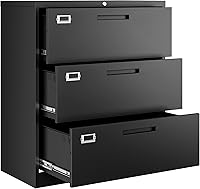
MIIIKO 4-Drawer Metal File Cabinet with Lock
Wood vs metal file cabinet: which should you choose?
Choose the storage job first and the material second. Wood can suit a living space, while a tall metal cabinet can keep several paper categories together without taking up a wide stretch of wall.
These examples also separate material from features. Both wood options roll, but only one has document locks; the metal option locks and stays on a straight base.
Wood vs metal file cabinet priorities
Start by deciding how many drawers must hold hanging folders. Then check folder size, access controls and the space available with a drawer fully open.
A household with one drawer of records and loose desk supplies has different needs from a business keeping several groups of paper files. More drawers help only when those drawers suit the contents.
Compare the three cabinets below by those needs. Their different shapes and layouts matter more than a simple claim that one material is always better.
| Product | Best for | Material | Drawers | Mobility | Our score |
|---|---|---|---|---|---|
| DEVAISE 3-Drawer Walnut Wood Under Desk File Cabinet | mixed desk storage | Wood | 3 | 5 casters | 8.2 |
| MIIIKO 4-Drawer Metal File Cabinet with Lock | larger paper collections | Cold-rolled steel | 4 | 8.6 | |
| VINGLI 2-Drawer Wood File Cabinet with Lock | shared home offices | Engineered wood | 2 | 5 wheels, 4 outer wheels lockable | 7.6 |
Which cabinet suits your daily filing?
Choose DEVAISE for mixed storage, MIIIKO for a larger paper collection, or VINGLI for a smaller collection needing drawer locks. Each solves a different problem, so the right choice depends on what will go inside.
DEVAISE: supplies and files beside your desk
The DEVAISE pairs a walnut finish with three drawers, but only the bottom drawer has hanging-file rails. Those adjustable rails fit letter, A4 or legal folders, leaving the upper drawers for items such as pens, printing paper and books.
That layout suits a desk where supplies otherwise spread across the work surface. It also keeps occasional paperwork nearby without making every drawer a filing drawer.
Skip it if you need three separate drawers of hanging folders or locked document storage. Its brakes secure the wheels, not the drawer contents.
Full-extension ball-bearing slides let you reach the back of each drawer. The DEVAISE file cabinet review gives more detail if this mixed-storage layout matches your desk.
MIIIKO: separate drawers for a larger paper collection
The MIIIKO uses cold-rolled steel and gives all four high-side drawers adjustable rails for letter, legal or A4 folders. This layout suits separate groups such as household records, client work, tax papers and reference files.
One top key lock secures every drawer, and two keys are included. Its drawer interlock includes an anti-tip mechanism, which supports safer use but doesn't replace correct assembly and placement.
Choose it when papers take priority over storage for small office items. Keeping several file groups in one cabinet also avoids spreading records across separate boxes.
Skip it if you need under-desk storage or expect to change its position often. Its tall shape and stationary base make it better suited to a planned floor location.
VINGLI: locking files in a shared room
The VINGLI has two file drawers with independent locks, making it a useful choice when paperwork shares a room with other household activities. Two keys are included.
Its P2-grade MDF construction has a rustic gray wood-grain finish. The drawers fit letter and A4 hanging folders, with full-extension ball-bearing slides for access to the rear.
Choose it if you want a short cabinet with document locks and wheels. Skip it for legal folders, since those need more room than letter or A4 files.
VINGLI specifies up to 55 lb per drawer, but that isn't a target to fill toward. Leave enough space for folders to slide and for your fingers to separate them.
How do wood and metal cabinets look in a home office?
Choose the finish that belongs in the room, then check the cabinet's visual size. A low cabinet beside a desk and a tall cabinet against a wall affect the room differently, even in matching colors.
Walnut works when you want the storage to read as furniture. Rustic gray offers a wood-grain look that can fit lighter or cooler room colors.
The MIIIKO's black painted steel can coordinate with black desk legs, shelves or office equipment. A tall cabinet remains visible above desk height, so consider it from the room's doorway as well as your chair.
Wood labels also need care: wood, engineered wood and solid wood aren't interchangeable descriptions. Don't assume a wood-grain finish means solid lumber.
Our guide to choosing a wood file cabinet covers finish and placement choices. For options organized around workspace needs, see file cabinets for a home office.
How much filing space do you actually need?
Count the folders you already have before choosing a drawer count. Separate papers worth keeping from duplicates and expired documents so you don't buy storage for clutter.
Group the remaining folders by how often you use them. Daily files should be easy to reach, while records opened once a year can occupy less convenient positions.
Don't confuse drawer count with file capacity. The DEVAISE's upper supply drawers serve a different purpose from the MIIIKO's dedicated file drawers.
Check the physical hanging folders, including their hooks and tabs, rather than measuring only the paper inside. A folder needs to hang freely, move along its rails and clear the drawer above it.
Our guide to hanging folders and file cabinet rails explains the setup. If drawer shape is still undecided, compare lateral and vertical file cabinets before settling on a material.
Which cabinet fits under a desk or beside it?
Measure the usable opening and the drawer's path, not just the cabinet's closed footprint. Desk aprons, cable trays, crossbars and chair arms can all block an otherwise plausible fit.
The VINGLI measures 15.7 inches wide by 15.7 inches deep by 27.2 inches high, including casters. That height can rule it out beneath a low desk even when its width fits.
The DEVAISE is about 18.2 inches wide and 15.6 inches deep. DEVAISE gives overall heights of both 25.2 and 26 inches, so confirm the assembled height before buying for a tight opening.
The MIIIKO measures 15 inches wide by 17.71 inches deep by 50.11 inches high. Plan a separate floor position with access to its top drawer and no low shelf blocking use.
Mark the footprint on the floor and sit in your usual position. Check that a cabinet beneath the desk won't force your knees sideways or leave you reaching around a chair to open it.
Leave some clearance above a rolling cabinet instead of planning a friction-tight fit. The standard file cabinet size guide can help you map the space before rearranging furniture.
Does wood or metal offer better document security?
Choose by the lock arrangement, not the cabinet material. Drawer locks help restrict routine access, but a file cabinet isn't a substitute for a safe when documents need stronger protection.
A single lock for every drawer is convenient when one person controls the whole collection. Independent locks can be useful when you want to close one drawer while continuing to use another.
Keep the spare key away from the cabinet, and agree on access if several people use the room. Leaving the key in the lock defeats the purpose of closing it.
Don't assume steel construction means protection from fire or water. None of these cabinets has a stated fire-protection rating, so store irreplaceable originals according to their protection needs.
Separate privacy from stability, too. A wheel brake controls movement, a drawer lock controls access, and an anti-tip feature addresses a different risk.
Is a wood or metal file cabinet easier to move?
Choose wheels for routine repositioning, but plan around the cabinet's weight and your floor. Casters help across a clear floor; stairs and raised thresholds still call for suitable lifting help.
The DEVAISE weighs 42.3 lb and has five casters, including two front wheels with brakes. The VINGLI weighs 44 lb and has five wheels, with all four outer wheels lockable.
Both include a center wheel for added support. Keep that wheel fitted as directed rather than leaving it off to simplify assembly.
The MIIIKO weighs 90 lb and has a straight base. Choose its location before filling it, especially if the route includes narrow doorways or stairs.
Empty drawers before a major move, close them and clear the route. Avoid pulling a cabinet by a drawer handle or forcing small wheels over an obstacle.
Our file cabinet weight guide covers moving and loading considerations. Once a rolling cabinet is in place, engage its brakes before using the drawers.
How should you assemble and load a file cabinet?
Assemble it fully, check drawer movement and load the lower storage first. All three cabinets require assembly, so allow a clear work area where panels and hardware can stay organized.
Check the parts against the instructions before starting. Follow the stated order, since attaching rails or panels backward can mean taking several steps apart.
Set the cabinet square and level before loading it. If a drawer rubs or won't close, check alignment, rail placement and trapped hardware rather than forcing it shut.
Fit the hanging rails for your folder size, then add a small group of folders to check clearance. Make sure tabs don't catch and folder hooks remain seated as the drawer moves.
Keep heavier contents low and spread weight evenly. Open one drawer at a time, and don't use an open drawer as a shelf or step.
Follow the cabinet's anchoring instructions where applicable, even when it has a support wheel or interlock. Our guide to keeping a file cabinet from tipping explains placement and everyday habits.
How do you care for wood and metal file cabinets?
Keep surfaces dry, clean gently and correct small drawer problems early. Wood and metal need different care at damaged surfaces, but neither benefits from spills left around joints or hardware.
For wood and engineered wood, remove dust with a soft cloth and use a lightly damp cloth for marks. Dry the surface afterward, especially near edges, seams and drawer fronts.
DEVAISE describes its finish as scratch- and stain-resistant, while VINGLI describes its surface as scratch- and water-resistant. Those claims don't make either cabinet immune to pooled liquid, abrasive cleaners or dragged objects.
For painted metal, wipe away moisture and use mild cleaning products compatible with the finish. Inspect scratches that expose metal, particularly if the room is damp.
Keep paper scraps and loose clips away from slides and casters. Follow the care instructions before applying any lubricant, since the wrong treatment can leave residue around files.
If movement changes, check for overloaded folders, a shifted cabinet or loose fasteners. Pushing harder can damage a drawer that only needs an obstruction removed.
What mistakes should you avoid before ordering?
Avoid choosing by appearance before checking file fit, clearance and access. These checks prevent the most costly mismatch: a cabinet that occupies the right spot but can't do the required job.
- Counting every drawer as a file drawer. Some are intended for supplies.
- Assuming all paper sizes fit. Legal folders need explicit support.
- Using desktop height as clearance. Measure below the lowest obstruction.
- Treating brakes as document locks. They control different things.
- Filling every drawer tightly. Crowded folders are harder to search and can catch.
- Planning to roll a loaded cabinet over steps. Empty it and arrange suitable help.
Decide how you'll label the contents before filling the drawers. A simple set of useful categories works better than many tiny groups that are hard to maintain.
Our home filing system guide helps turn empty drawers into a system you can keep using.
Which wood vs metal file cabinet should you buy?
Choose DEVAISE if supplies and one drawer of files share your desk; choose MIIIKO if several drawers of paperwork need one locking cabinet. Choose VINGLI if two drawers are enough and you want document locks in a rolling wood-grain design.
Rule out poor fits before comparing finishes: VINGLI won't suit legal folders, DEVAISE won't secure documents, and MIIIKO won't fit beneath a desk. That leaves a wood vs metal file cabinet decision based on your actual room and records.
Before ordering, write down your folder size, available clearance and required lock arrangement. If none of these layouts fits, use the complete file cabinet buying guide to choose a better storage shape.
Frequently asked questions
Is a wood or metal file cabinet better?
Choose wood for a furniture-style finish and metal when the cabinet's storage layout better suits your papers; material alone doesn't decide security or mobility. Here, DEVAISE combines supplies and files, MIIIKO provides four dedicated file drawers, and VINGLI offers two locking drawers in a rolling wood-grain cabinet.
Are wood file cabinets strong enough for files?
Wood file cabinets can hold hanging folders when their drawers and rails are designed for that job; follow the cabinet's load limits and spread contents evenly. VINGLI specifies up to 55 lb per drawer, but that figure doesn't apply to other wood cabinets or to the cabinet top.
Do all metal file cabinets lock?
No, metal construction doesn't mean a cabinet has document locks; check which drawers the lock secures and how the key works before buying. The MIIIKO here uses one top key lock for all four drawers, while the engineered-wood VINGLI has independent drawer locks and also includes two keys.
Can a wood file cabinet go under a desk?
Yes, if its assembled dimensions fit beneath the desk and leave space for your legs and open drawers; measure below the apron and any crossbars, rather than using desktop height. Include casters in the cabinet height, and leave enough clearance to roll it out without scraping the desk.